
Table of Contents
What’s Happening When Your Jaw Clicks?
Common Causes of Jaw Clicking When Chewing
Harmless Click or TMJ Problem? How to Tell
How to Ease Jaw Popping at Home
When Jaw Clicking Needs Professional Attention
Ready to Find Out What’s Behind the Click? Book an Assessment
Jaw clicking when chewing usually happens when the small cartilage disc inside your jaw joint slips slightly out of place and then snaps back as your mouth opens or closes. On its own, a painless click or pop is common and rarely a sign of damage. It deserves attention when it comes with pain, a jaw that catches or locks, trouble opening your mouth fully, or a change in how your teeth fit together, since those can signal a temporomandibular disorder (TMD) worth having evaluated.
This article is general education, not a diagnosis. Jaw pain has several possible causes, and some have nothing to do with the jaw joint. A jaw that locks open or closed, jaw pain with chest pressure or shortness of breath, or new pain while chewing that comes with headache, scalp tenderness, or vision changes needs prompt medical care rather than home remedies.
Key Takeaways
- Most jaw clicking comes from the joint’s cushioning disc shifting forward and slipping back into place as the mouth opens and closes.
- A painless click with normal jaw movement typically doesn’t need treatment, and it often stays stable for years.
- Pain, catching, locking, or limited opening are the signs that separate a harmless noise from a TMJ problem.
- Simple, reversible steps like softer foods, breaking clenching habits, and gentle jaw care are the recommended starting point.
- Jaw pain that builds while chewing can occasionally point to conditions outside the jaw joint, which is why a careful exam matters.
What’s Happening When Your Jaw Clicks?
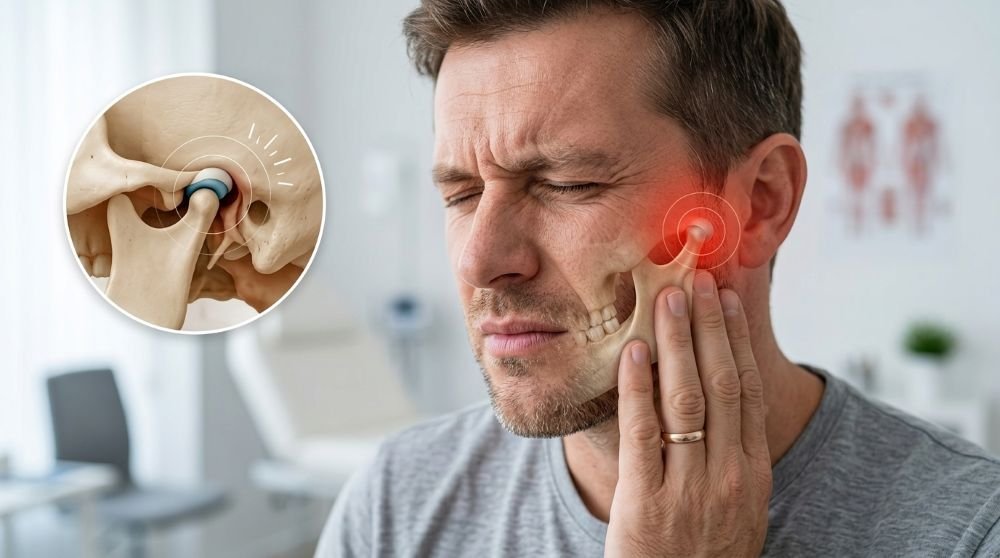
You have two temporomandibular joints (TMJs), one in front of each ear, where your lower jaw meets your skull. Each one works as both a hinge and a slide. When you open wide or chew, the rounded top of the jawbone, called the condyle, rotates and then glides forward. A small disc of cartilage sits between the bones and travels with the condyle to keep that motion smooth.
The click usually comes from that disc. When it sits slightly forward of where it belongs, the condyle has to ride over its back edge as your mouth opens, producing a click or pop as the disc snaps back into position. A second, softer click often follows as you close and the disc slips forward again.
Clinicians call this disc displacement with reduction, and it’s far more common than most people expect. A systematic review found that disc displacement affects an estimated 18% to 35% of the general population and, for most people, is a stable, pain-free condition that can last a lifetime.
The jaw’s disc also behaves differently from the discs in your back. It isn’t a gel-filled cushion that can bulge or herniate like a spinal disc. It’s a firm, flexible pad, and the usual issue is its position rather than material pushing out of it.
Common Causes of Jaw Clicking When Chewing
A click when you chew usually has a mechanical cause, but habits, muscle tension, stress, and even your neck can influence how the joint moves.
1. A Disc That Slips Forward and Back
Chewing repeats the open-and-close cycle dozens of times per meal, so a displaced disc that slips back into place will tend to click with each bite. In a pooled analysis of studies that used standardized diagnostic criteria, disc displacement with reduction was the most common jaw joint diagnosis among adults.
2. Clenching, Grinding, and Chewing Habits
Clenching and grinding (bruxism) load the joint and tire the chewing muscles. Smaller habits add up too: chewing on pens, ice, or nails, taking large bites, using your teeth as tools, clenching during the day, and sleeping on your stomach can all make TMD worse. Chewing gum for hours keeps the joint working with little rest.
3. Wear in the Joint
A grating or crunching sound, rather than a crisp click, is more often linked to wear of the joint surfaces, such as osteoarthritis. It tends to appear later in life and is worth having assessed, especially if it comes with stiffness or aching.
4. Neck Tension and Posture
The jaw and neck share muscles and nerve pathways, so problems in one area often show up alongside the other. In a study of 483 adults from the general population, neck pain was significantly associated with jaw symptoms, particularly facial and jaw pain. The role of posture itself is less settled, since a systematic review found little evidence tying overall body posture to TMD. If your neck pain travels into your shoulder or arm, that points to a different problem, explained in our guide to a pinched nerve in the neck.
5. Stress
Stress often shows up as clenching, sometimes without your noticing. In a Finnish working population, frequent painless jaw joint symptoms affected about 1 in 10 people and were significantly associated with self-reported stress and depression.
6. Jaw Injury
A blow to the jaw, a fall, or holding your mouth open wide for a long time can strain the joint and its ligaments. Clicking that starts after an injury deserves a professional look.
Harmless Click or TMJ Problem? How to Tell
The noise itself matters less than what comes with it. When jaw clicking causes no pain and doesn’t limit movement, it likely won’t need treatment, while constant jaw pain or a jaw you can’t fully open or close is a reason to get checked.
| What You Notice | Usually Harmless | Worth Getting Checked |
| Sound | Occasional painless click or pop | Clicking with pain, or a new grating sound |
| Movement | Jaw opens and closes fully | Jaw catches, locks, or opens less than usual |
| Pain | None, or brief soreness after a tough meal | Lingering ache in the jaw, face, ear, or temple |
| Bite | Teeth meet the way they always have | Bite suddenly feels off |
| Trend | Stable for months or years | Louder, more frequent, or more painful over time |
One pattern deserves special mention: clicking that suddenly stops and is replaced by a jaw that won’t open fully. That can mean the disc is no longer slipping back into place, sometimes called a closed lock. It’s uncommon, but it’s one of the clearest signs to seek an evaluation rather than wait.
Even when jaw symptoms flare, the outlook is generally good. In a 2-to-3-year follow-up of TMD patients with low pain-related impairment, muscle-related diagnoses dropped from about 68% to 23%, while clicking from disc displacement stayed roughly the same. In other words, the click often stays while the pain settles. Like many musculoskeletal problems, jaw pain tends to ease with time, much as sciatica often resolves on its own along a fairly predictable timeline.
How to Ease Jaw Popping at Home
If your jaw popping is painless, no fix is required. If it comes with mild soreness, the recommended starting point is simple, reversible care such as softer foods, heat or cold with gentle jaw stretches, and cutting back on clenching and gum chewing, while avoiding treatments that permanently change the teeth, bite, or jaw joint.
1. Give Your Jaw a Softer Week
During a flare, choose foods that need less chewing, cut food into smaller pieces, and skip very hard or chewy options like tough meat, bagels, and ice.
2. Keep Bites Small and Even
Avoid opening wide for big bites, and chew on both sides rather than favoring one.
3. Find Your Jaw’s Rest Position
At rest, your lips are closed, your teeth are slightly apart, and your tongue sits lightly on the roof of your mouth. If you catch your teeth touching during the day, you’re probably clenching.
4. Use Heat or Cold
A warm compress can relax tight chewing muscles, and a cold pack can calm soreness after a flare. Use whichever feels better for 10 to 15 minutes at a time.
5. Take Breaks From Desk Work
Long stretches hunched over a screen tend to bring clenching and neck tension with them. Set a reminder to stand, roll your shoulders, and unclench your jaw. If sitting also bothers your back or legs, these sciatica stretches you can do at your desk fit easily into the same breaks.
6. Ask About Over-the-Counter Pain Relief
Anti-inflammatory medication can ease soreness during a flare. Check with a pharmacist or physician first, especially if you have stomach, kidney, or heart concerns or take other medications.
7. Don’t Force the Pop
Shifting your jaw side to side to make it click, or prying it open to “reset” it, adds strain to an already irritated joint. Instead, note when the click happens and whether it hurts. That pattern is useful information for any provider you see.
When Jaw Clicking Needs Professional Attention
Consider seeking care if you notice:
- Clicking or popping that comes with pain in the jaw, face, ear, or temple
- A jaw that catches, locks, or won’t open as wide as it used to
- Soreness that hasn’t improved after a couple of weeks of home care
- Symptoms that started after a blow to the jaw, a fall, or an accident
- A bite that suddenly feels different
- A jaw stuck open or closed (seek urgent care)
- Jaw pain with chest discomfort, shortness of breath, sweating, or nausea (call 911)
Two of these deserve a closer look. Jaw discomfort can be a heart symptom, since pain in the jaw, neck, arms, back, or shoulders can accompany a heart attack, and anyone who suspects one should call 911 even if they aren’t sure. And in older adults, jaw pain that occurs with chewing can be a symptom of giant cell arteritis, an inflammation of the blood vessels in the head.
The timing offers a clue: jaw joint pain usually starts as soon as the jaw moves, while the pain of this condition tends to build after a few minutes of chewing. Because it needs prompt medical treatment, new chewing pain alongside headache, scalp tenderness, or vision changes should be seen by a physician the same day.
How a Chiropractor Fits In
A chiropractor can examine how your jaw opens, closes, and tracks, check the chewing muscles and joints for tenderness, and assess your neck and posture, since jaw and neck problems often travel together. Just as important, the exam screens for signs that call for a dentist, orofacial pain specialist, or physician instead.
The research on hands-on care is still developing. A review of randomized trials found no high-quality evidence for manual therapy or exercise in TMD, leaving real uncertainty about how well they work, while a later meta-analysis reported improvements in pain and mouth opening after manual therapy that lasted longer when combined with therapeutic exercise. A gentle, low-force approach matched to your exam findings, rather than forceful jaw or neck manipulation, is the most reasonable way to apply that evidence.
Frequently Asked Questions
Why does my jaw click when I chew but not hurt?
Most often, the disc inside the joint sits slightly forward and slips back into place as you open. A painless click with full, easy jaw movement is common and usually doesn’t need treatment.
Is jaw popping a sign of TMJ?
Not by itself. Jaw popping becomes a TMJ concern when it comes with pain, catching or locking, limited opening, or a change in your bite.
Can jaw clicking go away on its own?
Sometimes, but painless clicking often stays the same for years without causing problems. Jaw pain linked to TMD, on the other hand, frequently settles over time with simple self-care.
Why does my jaw click when I yawn or open wide?
Opening wide takes the joint through its full range, which is when a displaced disc is most likely to slip back into place with a click. Supporting your chin with your hand while yawning can limit how far the jaw opens.
Should I worry if my jaw clicks on only one side?
One-sided clicking is common, since each joint can behave differently. Watch for pain, locking, or a change in how your teeth meet on that side.
Can a chiropractor help with jaw clicking?
A chiropractor can assess your jaw, neck, and posture, screen for signs that need referral to a dentist or physician, and use gentle manual techniques and home exercises when they fit your findings. Painless clicking on its own usually doesn’t need hands-on treatment.
Ready to Find Out What’s Behind the Click? Book an Assessment
A painless click usually isn’t something to lose sleep over. But when jaw popping comes with pain, catching, or tension that spreads into your face, head, or neck, it helps to know exactly what’s driving it.
Tao Chiropractic in Pasadena starts every new patient with a consultation, a full spinal exam, orthopedic and neurological testing, and digital X-rays when needed, along with a close look at how your jaw opens, closes, and tracks.
TMJ care relies on gentle, controlled techniques rather than forceful adjustments, with referral to a dentist or physician when your exam calls for it. If you’re tired of wondering about the click every time you chew, schedule a new patient visit and get a clear answer.
READ MORE: Can a Chiropractor Help With Migraines? What the Research Says