
Table of Contents
Why Sleep Position Affects Back Pain
The Best Sleeping Positions for Back Pain
How to Set Up Your Sleep Position for Back Pain Relief
When Morning Back Pain Signals Something More
Ready for a Sleep Setup That Actually Supports Your Spine? Book a Spinal Assessment
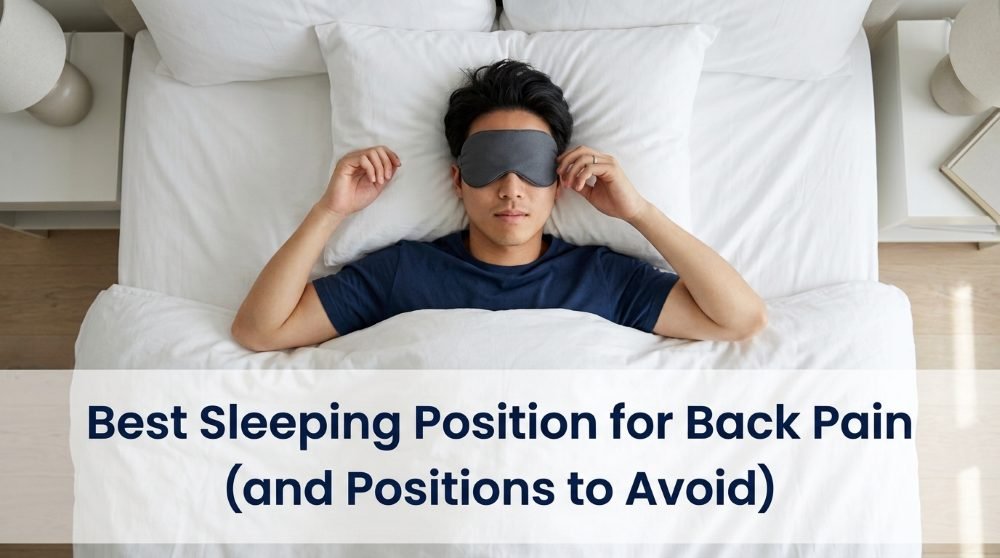
The best sleeping position for back pain is generally on your back with a pillow under the knees, or on your side with a pillow between the knees, both of which keep the spine in a neutral, supported position overnight. Stomach sleeping and tightly curled or twisted positions place the most strain on the lower back and are worth avoiding. This guide covers common mechanical back pain; persistent, worsening, or radiating symptoms are worth having assessed by a professional rather than managed with sleep changes alone.
Key Takeaways
- Back sleeping with a knee pillow and side sleeping with a knee pillow are the two positions most consistently linked to better spinal alignment.
- A 2025 systematic review found stomach sleeping is the position most consistently linked to worse low back pain outcomes.
- Pillow placement matters as much as the position itself. An unsupported knee or neck cancels out the benefit of an otherwise good position.
- Mattresses generally lose meaningful support after 7 to 10 years, which can undo good sleep posture no matter what position you favor.
- Morning stiffness lasting more than 30 minutes, or pain that eases with movement rather than rest, is worth a professional evaluation.
Why Sleep Position Affects Back Pain
Your spine has natural curves at the neck, mid-back, and lower back that are designed to stay supported, not flattened or exaggerated, while you’re lying down. When a sleep position pulls those curves out of alignment for hours at a time, the surrounding muscles and ligaments end up compensating for the load your spine should be carrying passively.
Researchers have been studying this connection for years, and the evidence base is still developing. A 2019 scoping review published in BMJ Open noted that while a relationship between sleep posture and spinal symptoms is clinically plausible, more rigorous studies were needed to confirm exactly how strong that link is. More recent research has sharpened the picture considerably. A 2025 systematic review in Musculoskeletal Care found that supine (back) sleeping supports spinal alignment and is associated with a lower prevalence of low back pain, while prone (stomach) sleeping increases the risk due to lumbar strain, and side-lying sits somewhere in between depending on how well it’s supported.
The Best Sleeping Positions for Back Pain
Two positions come up consistently in the research and in clinical guidance as the most supportive for a sore lower back.
Back Sleeping With a Pillow Under the Knees
Sleeping on your back distributes body weight evenly and allows the spine to settle into a neutral position, provided the setup is right. According to Henry Ford Health, a pillow placed under the knees takes pressure off the lower back and helps maintain the spine’s natural curve, and a flatter, contoured pillow under the head works better than a thick, fluffy one, which tends to push the neck forward out of alignment.
Side Sleeping With a Pillow Between the Knees
Side sleeping is a solid option when it’s set up correctly, and it’s often more comfortable for people who snore or have sleep apnea. The key is keeping the legs relatively straight rather than tightly curled, with a pillow between the knees to keep the pelvis level and prevent the top leg from pulling the spine out of alignment. This is a meaningfully different position from the fetal position (knees drawn tightly toward the chest), which tends to create uneven weight distribution across the spine and joints.
READ RELATED BLOG: Why Does My Back Hurt When I Wake Up? 7 Possible Causes and Fixes
Sleeping Positions to Avoid
Two patterns show up repeatedly as the ones most likely to aggravate a sore back.
Stomach Sleeping
Sleeping on your stomach flattens the lower back’s natural curve and forces the neck to turn to one side for hours at a time. Keck Medicine of USC notes that this position puts the most pressure on the spine’s muscles and joints of any sleep position, since it works against the spine’s natural alignment rather than supporting it.
Tightly Curled or Twisted Side Positions
Curling tightly into the fetal position, or twisting the torso relative to the hips, creates an uneven distribution of weight through the spine and surrounding joints. Keck Medicine points to this as a common but avoidable habit, one that’s usually easy to correct by straightening the legs and adjusting knee support rather than switching positions entirely.
Quick comparison:
- Favors spinal alignment: back sleeping with a knee pillow, side sleeping with a knee pillow and straighter legs
- Puts strain on the spine: stomach sleeping, tightly curled or twisted side positions
How to Set Up Your Sleep Position for Back Pain Relief
- Choose a base position
Start with back or side sleeping rather than stomach sleeping.
- Add a knee pillow
Place a pillow under your knees if you’re on your back, or between your knees if you’re on your side.
- Match your pillow height to your spine
Your neck should stay level with your spine, not tilted up or dropped down.
- Check your mattress
Most mattresses lose meaningful support after 7 to 10 years; a medium-firm option tends to be better supported by research than a very firm one.
- Ease into movement in the morning
Sit up slowly rather than jumping straight out of bed, giving your spine a moment to adjust.
- Track your patterns
Note which positions or nights correlate with worse pain. It makes your trigger easier to identify and gives a professional useful information if you do seek care.
When Morning Back Pain Signals Something More
Most morning back pain responds well to the adjustments above, but a few patterns are worth having looked at rather than managed alone:
- Pain that lasts longer than a few weeks despite consistent changes
- Numbness, tingling, or weakness radiating into the legs
- Pain that followed a fall, accident, or injury
- Stiffness lasting more than 30 minutes that eases with movement rather than rest
- Unexplained weight loss, fever, or changes in bowel or bladder function, which warrant prompt medical attention
None of these automatically mean something serious is going on, but they’re a signal that a proper evaluation is more reliable than continuing to guess.
Frequently Asked Questions
What is the best sleeping position for back pain?
Back sleeping with a pillow under the knees, or side sleeping with a pillow between the knees, are the two positions most consistently linked to better spinal alignment and less morning pain.
Is it bad to sleep on your stomach if your back hurts?
Yes. Stomach sleeping flattens the lower back’s natural curve and forces the neck to turn, which puts sustained strain on the lumbar spine.
Does a pillow between the knees actually help?
Yes. It keeps the pelvis level and prevents the top leg from rotating the spine out of alignment, which matters as much as the position itself.
How long does it take to notice a difference after changing sleep position?
Some people notice less morning stiffness within a few nights, though it can take a few weeks of consistent positioning and pillow support to see a clearer pattern.
When should I see a professional about morning back pain?
If stiffness lasts longer than 30 minutes, improves with activity rather than rest, or comes with numbness or weakness, it’s worth having a professional evaluate the underlying cause.

Ready for a Sleep Setup That Actually Supports Your Spine? Book a Spinal Assessment
Sleep position is one of the more fixable habits behind morning back pain, but it isn’t the whole picture. Mattress age, muscle strength, and underlying spinal issues all play a role too, and it’s not always obvious from the outside which one is driving your discomfort. Tao Chiropractic offers a thorough spinal assessment to help pinpoint what’s actually behind your morning pain, rather than leaving you to guess at fixes on your own. If you’re tired of waking up sore, a proper evaluation is a more reliable next step than trying every pillow on the market.
READ MORE: What Is Text Neck? Symptoms, Causes, and How to Protect Your Spine