
Table of Contents
Why Sitting at a Desk Aggravates Sciatica
Before You Start: Match the Stretch to Your Sciatica
6 Sciatica Stretches You Can Do at Your Desk
Sciatica Stretches to Skip or Modify at Work
How to Build Movement Into Your Workday
When Sciatica Needs More Than Desk Stretches
Ready to Sit Through Your Workday Without Leg Pain? Book a Spinal Assessment Today
The best sciatica stretches to do at a desk are gentle seated and standing moves that ease pressure on an irritated nerve without forcing it: a seated figure-4 stretch, a seated nerve glide, a standing backward bend, a standing hip flexor stretch, a seated forward lean, and seated pelvic tilts. Which ones help depends on what’s irritating the nerve, so the right stretch for one person can aggravate another. Pair them with a standing break every 30 minutes, and keep every stretch at mild tension, never sharp or spreading pain.
This guide covers typical, mild to moderate sciatica. Sudden leg weakness or numbness, numbness in the groin area, trouble controlling your bladder or bowels, or pain after a fall or car accident need immediate medical care rather than stretching.
Key Takeaways
- Mayo Clinic lists prolonged sitting as a sciatica risk factor, noting that people who sit a lot are more likely to develop herniated discs than active people.
- Most sciatica improves without surgery. AAOS reports that 80 to 90% of people get better over time, typically within several weeks when a herniated disc is the cause.
- The right stretch depends on the cause. Disc-related sciatica often eases with gentle backward bending, while spinal stenosis tends to ease with leaning forward.
- If a stretch pushes symptoms farther down your leg, stop. Symptoms retreating toward your lower back is the better sign.
- Standing up every 30 minutes, a habit Mayo Clinic suggests for anyone who sits a lot, breaks up the long, static sitting that tends to make sciatica worse.
Why Sitting at a Desk Aggravates Sciatica
Sciatica is pain caused by irritation or compression of the sciatic nerve, the body’s largest nerve, which runs from the lower back through the buttock and down each leg. Cleveland Clinic calls it one of the most common causes of leg pain seen in medical care, and the StatPearls clinical review from the National Library of Medicine puts its lifetime incidence between 10% and 40%. It’s a symptom rather than a diagnosis: the American Academy of Orthopaedic Surgeons (AAOS) explains that the cause is usually a herniated disc in people under 40 and bone spurs or arthritis in older adults.
A desk job works against that nerve in three ways:
- Sustained pressure. Mayo Clinic notes that sciatica pain can worsen with long periods of sitting.
- Rounded posture. StatPearls notes that forward bending and twisting of the lower spine aggravate sciatica, and a slumped desk posture holds the lower back bent forward for hours.
- Buttock compression. The sciatic nerve usually passes beneath the piriformis muscle, and Cleveland Clinic lists sitting for long periods among the causes of piriformis syndrome, where that muscle presses on the nerve.
Read our article on whether prolonged sitting can cause sciatica.
Before You Start: Match the Stretch to Your Sciatica
No single stretch suits every case. AAOS notes that people with lumbar spinal stenosis often feel better when they lean forward or sit, and worse when they stand up straight or walk. Among people whose symptoms respond to repeated movement, the StatPearls review of McKenzie back exercises reports that most do best with backward bending (extension), though some improve with forward bending instead.
These patterns are clues, not a diagnosis:
- Worse with sitting and bending forward: common with disc injuries such as a herniated disc. The standing backward bend and standing hip flexor stretch tend to suit this pattern.
- Worse with standing upright and walking, easier when sitting or leaning forward: the classic spinal stenosis pattern. The seated forward lean tends to suit it.
- Deep buttock pain that builds the longer you sit, with little back pain: can point to the piriformis muscle. The seated figure-4 stretch targets this area.
The seated nerve glide and seated pelvic tilts are gentle enough for most people to try. Three ground rules apply to all six:
- Aim for mild tension, not pain. Cleveland Clinic advises against pushing through back pain.
- Watch where your symptoms go. StatPearls describes symptoms spreading farther down the leg as a response to avoid, while symptoms moving back toward the spine is the desired one.
- Move slowly. Controlled movement is easier on a sensitized nerve than bouncing into a stretch.
6 Sciatica Stretches You Can Do at Your Desk
1. Seated Figure-4 Stretch (Piriformis Stretch)
Sit tall near the front edge of your chair with both feet flat. Cross your right ankle over your left knee and let the right knee drop out to the side. Keeping your back straight, hinge slightly forward from the hips until you feel a gentle stretch deep in the right buttock. Hold for 20 to 30 seconds, then switch sides. Repeat two or three times per side.
Best for: buttock-centered pain. StatPearls notes that piriformis-specific stretches help release tension in this muscle.
Modify if: hinging forward sends pain down your leg. Stay upright and let the crossed leg do the work.
2. Seated Sciatic Nerve Glide
Sit tall with your hands on your thighs. Slowly straighten the knee on your painful side while tilting your head back to look at the ceiling. Then bend the knee back down while bringing your chin toward your chest. Pairing the movements this way lets the nerve slide rather than stretch from both ends at once. Do 10 slow repetitions, once or twice a workday.
Best for: tingling or pulling along the back of the leg. A 2023 systematic review in the Journal of Manual & Manipulative Therapy found that six of eight trials reported better outcomes when nerve mobilization was added to conservative care, with short-term benefits for pain and function, though more high-quality research is needed.
Modify if: tingling increases or lingers afterward. Make the movement smaller, or skip it.
3. Standing Backward Bend
Stand beside your desk with your feet hip-width apart and your hands on the back of your hips, fingers pointing down. With your knees straight but not locked, gently lean back as far as is comfortable, pause for a second or two, then return to upright. Repeat 5 to 10 times. This is a standing version of the lower back extension (press-up) Cleveland Clinic lists among its sciatica stretches.
Best for: pain that builds with sitting and bending forward, a pattern common with disc-related sciatica.
Skip if: leaning back increases your leg pain, or your pain is worse when standing upright and walking.
4. Standing Hip Flexor Stretch
Sitting keeps the muscles at the front of your hips shortened. Hold the edge of your desk for balance and step one foot back into a short split stance. Gently tuck your pelvis under by squeezing the buttock of your back leg until you feel a stretch at the front of that hip. Hold for 20 to 30 seconds, then switch sides.
Best for: stiffness after a long stretch of sitting.
Modify if: you feel pinching in your lower back. Keep the pelvis tucked and avoid arching.
5. Seated Forward Lean
Sit near the front of your chair with your feet a little wider than your hips. Slowly lean forward, letting your chest move toward your thighs and your arms hang toward the floor. Hold for 10 to 20 seconds, then roll back up slowly with your hands on your thighs.
Best for: the stenosis pattern. AAOS notes that leaning forward can increase the space available for the nerves in people with spinal stenosis.
Skip if: your pain is worse with sitting and bending forward, which points more toward a disc-related cause.
6. Seated Pelvic Tilts
Sit tall with both feet flat. Slowly roll your pelvis backward so your lower back flattens into a slight slouch, then roll it forward so your lower back arches gently. Keep it small and pain-free, and repeat 10 times. It’s a chair version of the cat-cow exercise Cleveland Clinic lists among sciatica stretches.
Best for: anyone who has been sitting still too long. It also shows which direction, forward or back, feels better.
Sciatica Stretches to Skip or Modify at Work
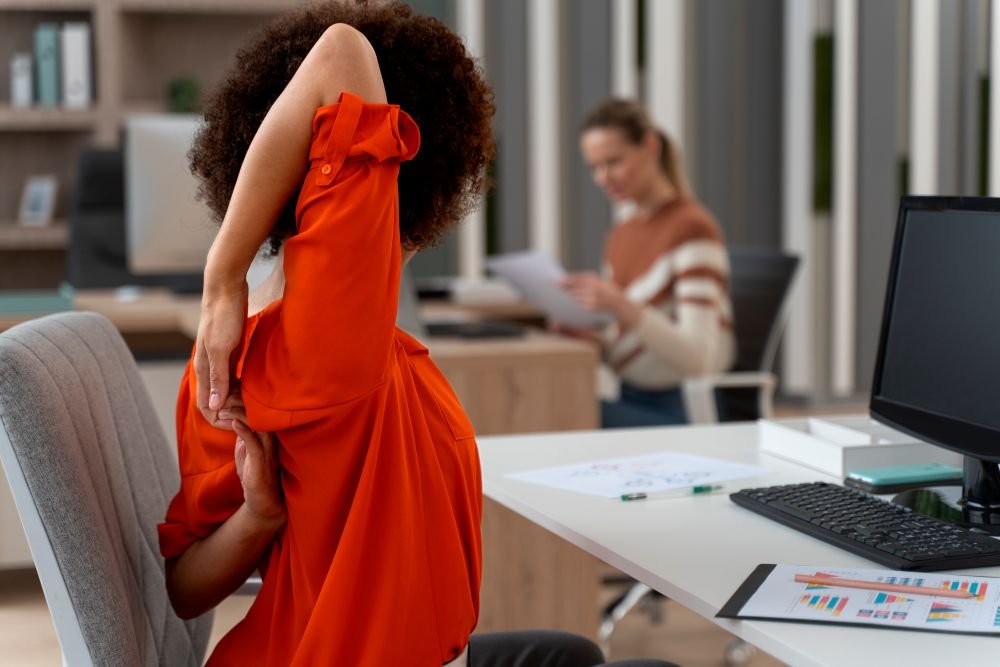
These common moves can backfire on an irritated nerve:
- Straight-leg hamstring stretches. Propping a straight leg on your desk and reaching for your toes pulls on the sciatic nerve much like the straight leg raise test providers use to check for sciatica. Keep the knee slightly bent and stop short of leg symptoms, or use the nerve glide instead.
- Forceful twists. Hooking an arm over the chair back to crank your spine adds leverage to twisting, a movement StatPearls lists among sciatica aggravators. A gentle turn within a comfortable range is fine.
- Standing toe touches. Folding forward from standing loads the lower back in the bent-forward position that tends to aggravate disc-related sciatica.
- Twisting to “crack” your back. The pop can feel satisfying, but it doesn’t address what’s irritating the nerve. Learn more about whether cracking your own back is bad for you.
How to Build Movement Into Your Workday
Stretches work best alongside less sitting overall. StatPearls recommends avoiding prolonged sitting, and AAOS encourages staying active and taking short walks rather than resting in bed.
- Stand up every 30 minutes. Mayo Clinic suggests a short standing break every 30 minutes. Use it for a few backward bends or a short walk.
- Walk at lunch. StatPearls lists regular light exercise such as walking among its self-care recommendations.
- Support your lower back. Mayo Clinic recommends a seat with good lower back support, a pillow or rolled towel in the small of your back, and knees and hips kept level.
- Empty your back pocket. Piriformis-related sciatica is sometimes called “wallet sciatica,” according to MedlinePlus, so take your wallet or phone out before you sit.
- Track your pattern. Note which positions and stretches make your leg symptoms better or worse. That record is useful to you and to any provider you see.
When Sciatica Needs More Than Desk Stretches
Mayo Clinic advises calling a healthcare provider if self-care doesn’t ease your symptoms, or if pain lasts longer than a week, is severe, or keeps getting worse.
Consider seeking care if you notice:
- Stretches that repeatedly push your symptoms farther down your leg
- Symptoms in both legs, which Cleveland Clinic notes is rare with sciatica
- Fever, night sweats, chills, or a history of cancer, which StatPearls lists as reasons to look for causes other than simple sciatica
- Sudden numbness or weakness in a leg, or pain after a car accident or fall (seek immediate medical care)
- Numbness in the groin area or trouble controlling your bladder or bowels, which AAOS describes as signs of cauda equina syndrome, a medical emergency
Frequently Asked Questions
What are the best sciatica stretches to do at a desk?
It depends on the cause. A seated figure-4 stretch targets buttock-centered pain, a standing backward bend often suits disc-related sciatica, and a seated forward lean tends to help spinal stenosis. A seated nerve glide and pelvic tilts are gentle options for most people.
How should I sit at my desk with sciatica?
Use a chair with good lower back support, add a rolled towel behind your lower back, keep your knees and hips level, and stand up briefly every 30 minutes.
Is walking good for sciatica?
Usually, yes. AAOS encourages short walks and staying active rather than resting in bed. With spinal stenosis, longer walks can bring on symptoms, so shorter walks or leaning slightly forward, such as on a shopping cart, may be easier.
How long does sciatica last?
Cleveland Clinic reports that many cases improve within four to six weeks without medical treatment, and AAOS notes that 80 to 90% of people improve without surgery. More severe cases can take several months.
Can a chiropractor help with sciatica?
A chiropractor can assess your spine, hips, reflexes, and strength to identify what’s irritating the nerve, screen for signs that need medical referral, and match stretches to your pattern. StatPearls lists spinal manipulation among treatment options, while AAOS cautions that manipulation can worsen symptoms with a herniated disc or osteoporosis, which is why a careful exam and a gentle, low-force approach matter. For a side-by-side look, read our guide to chiropractic care vs. physiotherapy for sciatica.

Ready to Sit Through Your Workday Without Leg Pain? Book a Spinal Assessment Today
Desk stretches can take the edge off a flare, but they can’t tell you why the nerve is irritated, and the wrong stretch can keep it that way. Tao Chiropractic in Pasadena starts every new patient with a consultation, a full spinal exam, orthopedic and neurological testing, and digital X-rays when needed, then builds a sciatica treatment plan around what the exam shows, using gentle, controlled techniques rather than forceful twisting. If sciatica follows you from your desk chair to your couch, schedule a new patient visit and find out which stretches actually fit your spine.
READ MORE: Pinched Nerve in the Neck: Symptoms, Causes, and How Long It Lasts